REVIEW · AUSTIN
Double Decker Austin Single Loop Sightseeing Tour
Book on Viator →Operated by Double Decker Austin Tours · Bookable on Viator
Austin is easier when you have a loop plan. This double-decker Austin sightseeing tour takes you around downtown landmarks with live guide commentary, plus real photo angles from the open top deck or a calmer ride downstairs.
You’ll like having two ways to ride. I love the choice between the open-air upper deck for views and the climate-controlled lower deck when the weather turns.
One thing to consider: this is a tight downtown circuit, so it’s not meant to cover every corner of Austin equally. Also, on the top deck you may need to duck when passing under low branches.
In This Review
- Key highlights at a glance
- Entering the Austin Visitor Center and choosing your best seat
- The loop system: why 75 to 90 minutes feels efficient
- Historic 6th Street, the Convention Center, and the Fire Museum stops
- Joseph and Susanna Dickinson Hannig’s home: Texas independence context
- William Sydney Porter and the Driskill Hotel: culture meets classic Austin
- Texas State Capitol and Governor’s Mansion: what you’re seeing and why it matters
- LBJ, the Texas stadium, and UT Austin’s tower from the bus window
- Museums and art: Texas history, Blanton Museum, and the Ransom Center
- Congress Avenue Bridge bats and South Congress at street speed
- Long Center and your best follow-up plan
- Photo and comfort tips for the open-air upper deck
- Price, value, and who this tour fits best
- FAQ
- FAQ
- How long is the Double Decker Austin Single Loop tour?
- Where does the tour start?
- Is the tour offered in English?
- Can I use a mobile ticket?
- What seating options do I have on the bus?
- Does the tour end back at the starting point?
- What are some of the major landmarks the route passes?
- Is this tour weather dependent?
- Is there free cancellation?
- How big is the tour group?
- Final call: should you book this Austin double-decker loop?
Key highlights at a glance

- Two-deck comfort: open-air top deck plus climate-controlled lower seating
- Live narration on a loop: you get context as you pass major downtown stops
- Photo-first upper deck: great angles for Austin’s skyline and landmark signs
- Classic must-sees: Texas State Capitol, the Driskill Hotel, and Governor’s Mansion area
- More than landmarks: you also get a museum and culture sweep (LBJ, art, writing, history)
- Small group feel: max 35 travelers, with smooth loading and easy orientation
Entering the Austin Visitor Center and choosing your best seat

Your tour starts at the Austin Visitor Center area at 103 E 5th St, in the downtown zone near Red River Street (between 4th and 5th). When you arrive, you’ll pick your seat and settle in quickly, because this tour is built for a single guided loop rather than long waits.
I really like that the bus gives you a simple decision right away. The open top deck is ideal if you want the breeze and wide views. The lower deck is your move if you’d rather stay dry, cooler, or out of the sun.
If you’re thinking about comfort, plan around the sun and timing. One review mentioned using the top deck in mid-80s weather for the breeze, and another noted the practical reality that you’ll sometimes need to duck on the outside when branches are low. It’s not dramatic, but it’s real—so wear a hat you don’t mind adjusting.
Other driving and sightseeing tours in Austin



The loop system: why 75 to 90 minutes feels efficient
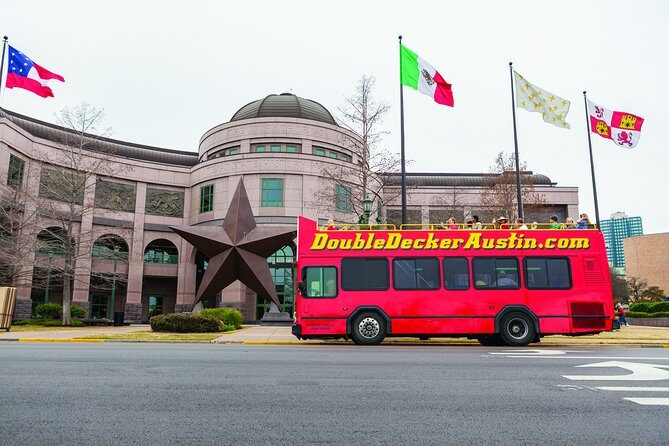
The whole ride clocks in around 1 hour 15 minutes to 1 hour 30 minutes. That short window matters in Austin, because traffic, heat, and parking can eat your time fast. With this setup, you get your bearings without committing to a full day of hopping between sites.
This tour is also a good “day one” tool. You’ll see the downtown pattern—major streets, key buildings, and where the popular neighborhoods start—so later you can choose what to walk back to.
Group size stays reasonable, with a maximum of 35 travelers. In practice, that usually means you spend less time stuck in crowds and more time actually watching the city go by and hearing the guide.
Historic 6th Street, the Convention Center, and the Fire Museum stops
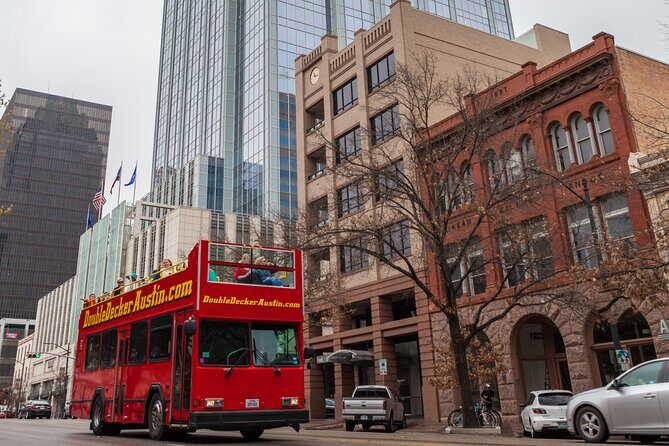
You start with the Historic 6th Street Entertainment District area. Even if you don’t plan to party, it helps to know where it is and what it looks like from the road—because so many Austin plans revolve around that stretch.
Next you pass the Austin Convention Center area. This is useful mostly as orientation. If you’re attending an event or concert later, you’ll recognize the area immediately when you’re back on your own.
Then comes a standout stop for anyone who likes local institutions: the Austin Fire Museum, located in Historic Central Fire Station No. 1. The museum is described as having uniforms, photos, and memorabilia spanning the 19th to 21st centuries. Even when you’re not doing a deep dive inside, seeing it on this route helps you understand what Austin preserves and celebrates.
Joseph and Susanna Dickinson Hannig’s home: Texas independence context
One of the more story-heavy stops is the 1869 home of Joseph and Susanna Dickinson Hannig. It was saved and deeded to the City of Austin in 2003, and Joseph built the home for his new wife, Susanna.
What makes this stop click with visitors is the connection to big Texas moments. The info provided with the tour notes that Susanna survived the Battle of the Alamo and carried news of its fall to Sam Houston. That chain of events is tied to Houston’s defeat of Santa Anna at the Battle of San Jacinto and ultimately the independence of the Republic of Texas.
If you’re the type who likes history that affects real people, this stop gives you a human entry point. If you’re not, it’s still a strong reminder that Austin’s downtown isn’t just skyline—it has layers.
William Sydney Porter and the Driskill Hotel: culture meets classic Austin
You’ll also explore the life of William Sydney Porter in Austin and take a look inside. The tour doesn’t list extra details here, but the structure is clear: this is a stop designed for you to connect a person to place, not just pass by a building.
Then you hit one of Austin’s most recognizable icons: the Driskill Hotel. It’s a Romanesque-style building completed in 1886 and described as the oldest operating hotel in Austin. The tour also points out it was conceived and built by Col. Jesse Driskill, who spent his fortune constructing what was framed as the finest hotel south of St. Louis.
From a tour value standpoint, this is a smart inclusion. The Driskill isn’t just a pretty stop. It’s a downtown anchor that helps you understand why Austin became a destination in the first place.



Texas State Capitol and Governor’s Mansion: what you’re seeing and why it matters
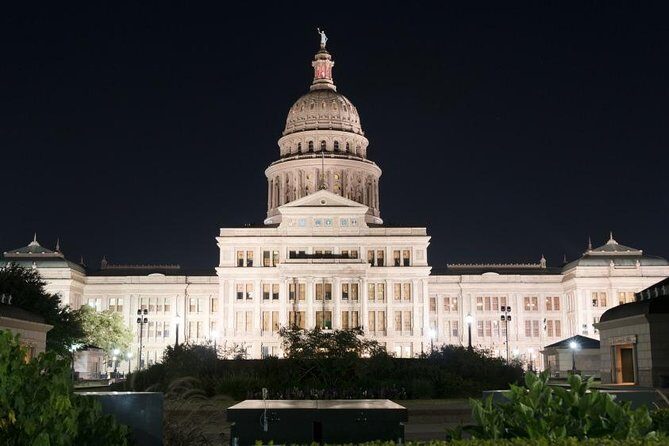
The Texas State Capitol area is one of the headline moments. The tour description notes it as one of the most distinguished state capitols in the U.S., with listings on the National Register of Historic Places and National Historic Landmark status.
Right near it, you’ll also cover the Governor’s Mansion. The tour states it has served as the official residence of Texas governors and their families since 1856, and it’s described as the oldest continuously occupied governor’s residence west of the Mississippi River.
The key detail here is the 2008 arson and the aftermath. The mansion was severely damaged, and the tour info says it was restored with broad support from preservationists, lawmakers, and Texans, and that it’s been fully restored to be occupied again. When a tour includes a real event like that, it turns the building from a photo stop into a story you can remember.
LBJ, the Texas stadium, and UT Austin’s tower from the bus window

You’ll pass the Lyndon Baines Johnson Library and Museum area, with a quote connected to the dedication in 1971. That matters because it signals the museum’s tone: it’s presented as showing the facts along with triumphs and failures, not just the feel-good version.
Next is Darrell K Royal–Texas Memorial Stadium, on the University of Texas campus. The tour info says it’s been home to the Longhorns since 1924. It also notes earlier official capacity figures (including a past capacity of 100,119) before later south end zone seating and luxury suite construction.
You’ll also see the UT Austin Tower, described as 307 feet tall and completed in 1937. It’s described as UT’s most distinguishing landmark and a symbol of academic excellence and personal opportunity.
A practical note: a couple of lower-rated comments complained that the university segment can feel like a lot. That doesn’t mean it’s “wrong,” but it does mean your preference matters. If your Austin priority is more street-level downtown flavor (like 6th Street and South Congress), you may want to mentally treat the UT stops as part of the same downtown-to-university arc.
Museums and art: Texas history, Blanton Museum, and the Ransom Center
This tour keeps going with a culture streak. The itinerary includes the Texas State History Museum, opened in 2001 as the official history museum of the State of Texas. You’ll also see the Blanton Museum of Art, described as Austin’s primary art collection and a major resource for the community, with more than 19,000 works.
Then there’s the Ransom Center at UT Austin, described as an internationally renowned humanities research center. The tour info says its collections provide insight into the creative process for writers and artists across literature, photography, film, art, and the performing arts.
Here’s the value for you: even if you don’t plan to spend hours inside, you’ll learn the names and locations. That makes it far easier to choose what to return for later. It’s also helpful if you’re traveling with someone who wants variety, because this tour doesn’t stay locked to politics and buildings only.
Congress Avenue Bridge bats and South Congress at street speed
You’ll also pass the Congress Avenue Bridge, which shelters the largest urban bat colony in North America. The tour info says between 750,000 and 1.5 million bats fly out near dusk, with best viewing dates listed as April through October.
If you’re visiting during that window, this is a smart heads-up stop. Even if you don’t plan a bat outing the same day, you’ll know exactly where to go and what the timing is supposed to look like.
After that, you roll toward South Congress (often called SoCo). The description frames it as a must-stroll area south of Lady Bird Lake, with homespun character, boutiques, eateries, galleries, and music venues. From a practical sightseeing angle, this is where you’ll start to see Austin’s personality shift from government-and-campus to “walk around and browse.”
Long Center and your best follow-up plan
Near the end, you’ll also pass the Long Center, described as producing and presenting performances, music, movies, hangouts, festivals, and other interests that bring people together. The tour frames it as connected to the local environment and a front-row invitation to help shape Austin culture.
And that’s the quiet win of this whole tour. You finish with a map in your head. You’ll know what to revisit for a timed show, what area is better for a quick walk, and which landmarks justify an extra hour on your own.
One more detail worth your attention: many guides end the experience at a place you can pop back into right after. Reviews specifically point out checking the gift shop at the end of the tour at the visitor center, which is a nice low-effort way to keep the momentum going.
Photo and comfort tips for the open-air upper deck
The top deck is the classic choice for a reason. You get more direct sightlines for landmark photos, and it’s easier to capture that “big downtown moment” feeling.
But plan for real-world Austin conditions. Expect to sometimes duck under low branches while seated outside, especially during certain stretches where trees hang over the street. If you’re tall, bring sunglasses and a hat you can manage quickly.
If you’re after the best balance, I’d do this: sit upstairs for landmark moments like the Capitol area and bridges, then switch down if you want to avoid sun glare or heat. Because the tour is relatively short, you don’t have time to be uncomfortable.
Price, value, and who this tour fits best
At $36.81 per person, this tour isn’t a budget bus ticket. But it’s also not priced like a private charter. The value comes from the combination of live narration, a route packed with major downtown anchors, and the convenience of a double-decker setup.
You’re paying for efficiency. In 75 to 90 minutes, you’ll cover a lot of named places you’d otherwise need to stitch together with rideshares, parking hunts, or a patchwork walking plan.
This tour fits best if:
- You’re on your first trip and want instant orientation
- You like seeing big downtown landmarks without spending your whole day walking
- You want a mix of Capitol history, museum names, and local neighborhood energy
It may feel less perfect if:
- You mainly want west-side downtown depth or a super specific neighborhood focus
- You strongly dislike campus-style stops
- You get impatient with guide humor style or delivery pace (the guide approach varies by person on any live tour)
FAQ
FAQ
How long is the Double Decker Austin Single Loop tour?
It runs about 1 hour 15 minutes to 1 hour 30 minutes.
Where does the tour start?
It starts at the Austin Visitor Center area at 103 E 5th St, Austin, TX 78701.
Is the tour offered in English?
Yes, it’s offered in English.
Can I use a mobile ticket?
Yes, the tour includes a mobile ticket.
What seating options do I have on the bus?
There’s an open-air top deck and a climate-controlled lower deck.
Does the tour end back at the starting point?
Yes, the activity ends back at the meeting point.
What are some of the major landmarks the route passes?
The tour highlights include 6th Street, The Driskill Hotel, Texas State Capitol, and the Texas Governor’s Mansion, plus stops connected to LBJ, UT landmarks, Congress Avenue bats, and South Congress.
Is this tour weather dependent?
The experience requires good weather. If it’s canceled due to poor weather, you’ll be offered a different date or a full refund.
Is there free cancellation?
Yes. You can cancel up to 24 hours in advance for a full refund.
How big is the tour group?
The tour has a maximum of 35 travelers.
Final call: should you book this Austin double-decker loop?
I’d book it if you want a fast, structured way to understand downtown Austin and pick your next stops. The double-decker setup is genuinely useful—up top for views, down below for comfort—and the route ties together Capitol landmarks, classic Austin hotels, and major museum and neighborhood areas without turning your day into a logistics headache.
Skip it only if your ideal Austin trip is hyper-focused on one side of town or you already know your way around and don’t need this kind of orientation. For most first-time visitors, it’s a smart way to turn a limited day into a clear game plan.